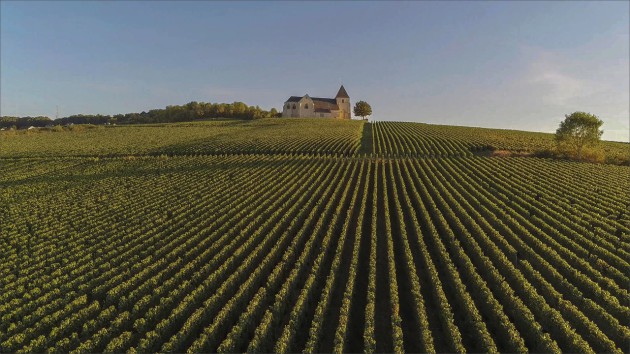
Friday read: Champagne’s slow but steady march to organic
As Champagne celebrates an exceptional vintage, recent news has been less positive for the region’s organic producers: the rate of conversions has been fairly static over the past two years. But Ludovic du Plessis, CEO of organic producer Champagne Telmont, remains optimistic about organics’ future in the region.
“One hundred per cent organic is possible, it’s doable,” says Du Plessis. “It’s a question of philosophy.”
But he adds: “The only way to do it is for the big champagne houses to pay more to help growers convert. They have a certain margin and they can save elsewhere. That will help create a snowball effect.” Telmont pays its growers in conversion a 30 per cent price premium on their grapes.
Drappier is the largest house now approaching full organic certification, and went carbon neutral in 2016, the first Champagne estate to do so. Louis Roederer owns the largest organically certified vineyard in Champagne, at 135 hectares, while Lanson, Perrier-Jouët and Mumm have adopted some organic, biodynamic or regenerative methods.
Telmont has been moving towards organic production since 2017, when it received its first certification. The latest organic wine in their range is its Réserve de la Terre Rosé. The producer aims to make its whole production of around 400,000 bottles a year organic by 2031. At present 95 per cent of the estate vineyards and 70 per cent of its growers are certified.
Telmont also aims to switch to regenerative viticulture and get ROC certification. It is aiming to be net zero by 2050
At present around seven per cent of Champagne’s production is certified organic or in conversion – a big increase over the one per cent that was organic in 2009, though lower as a proportion of the total than in many French regions. There was a slight rise in conversions last year, despite weather challenges, though Jérôme Bourgeois, president of the Association des Champagnes Biologiques (ACB), concedes that: “It’s at a bit of a plateau.”
There has been criticism in recent years of Champagne’s slow progress in reducing the use of herbicides. In 2018, a goal was announced of zero herbicides by the end of 2025: Syndicat Général des Vignerons president Maxime Toubart declared: "The goal is to be able, in a few years, to speak of a 100 per cent sustainable, committed, and exemplary Champagne region, and to be able to boast zero herbicides." But that decision was reversed in April 2022, prompting an open letter of protest by the ACB to Le Monde.
The herbicide glyphosate, whose use in France is partially restricted, remains in extensive use in Champagne. “It’s also much more expensive to work [weed control] mechanically so herbicides are easier,” says Bourgeois. “The majority of growers don’t have a real economic interest in working without herbicides.”
Du Plessis admits that in difficult years like 2023 and 2024, organic producers have a harder time but insists that it is a question of philosophy. “Yes, you are going to lose 20, 30 per cent in some years but you do better in others,” he says. “And we pay a 30 per cent premium. Using the réserve individuel [now formally known as réserve interprofessionelle] also helps.”
“It’s better for the soil, it’s better for the health of the winegrowers, and it’s a benefit for the wine,” adds Du Plessis. “You have this freshness [in the wine], it’s full of life”.
Andrew Neather blogs here. His new book with Jane Masters MW, Rooted in Change: The Stories Behind Sustainable Wine, is published on 1 October by the Academie du Vin Library.
Keywords:
Search
Digital Editions





56-58 Church Walk, Burgess Hill, West Sussex, RH15 9AN
Registered in England No. 6646125. VAT No. 938 4452 95
