
Wine and spirits sector hits back at tax as duty revenues fall
The wine and spirits sector has hit back against what the Wine and Spirit Trade Association (WSTA) called “the UK's uniquely punitive excise duty regime”.
This comes after new HMRC data published today (23 April) revealed that government income from wine and spirits duties fell £188m in 2025/2026 compared to 2025/2024.
This represents an equal £94m fall in revenue from both the wine and the spirits sectors, respectively.
- Read more: Fladgate Family Wines declares 2024 vintages
For contrast, beer duty revenues fell by £68m, while cider duties actually grew by £74m.
Commenting on the data, Miles Beale, chief executive of the WSTA, said: “Not only do wine and spirit drinkers pay the highest rates of excise duty and contribute the lion’s share (c.70%) of all alcohol duty receipts to the public purse, they have also been hit hardest by the UK's uniquely punitive excise duty regime.
“With every new set of data, we see clearly that increasing duty rates year-on-year reduce consumer demand and income to the Exchequer.
But there's a chance to stop the 'drip, drip, drop': the government’s recently announced evaluation of the 2023 duty provides a clear opportunity for a major re-think as part of the 2026 Autumn Budget.”
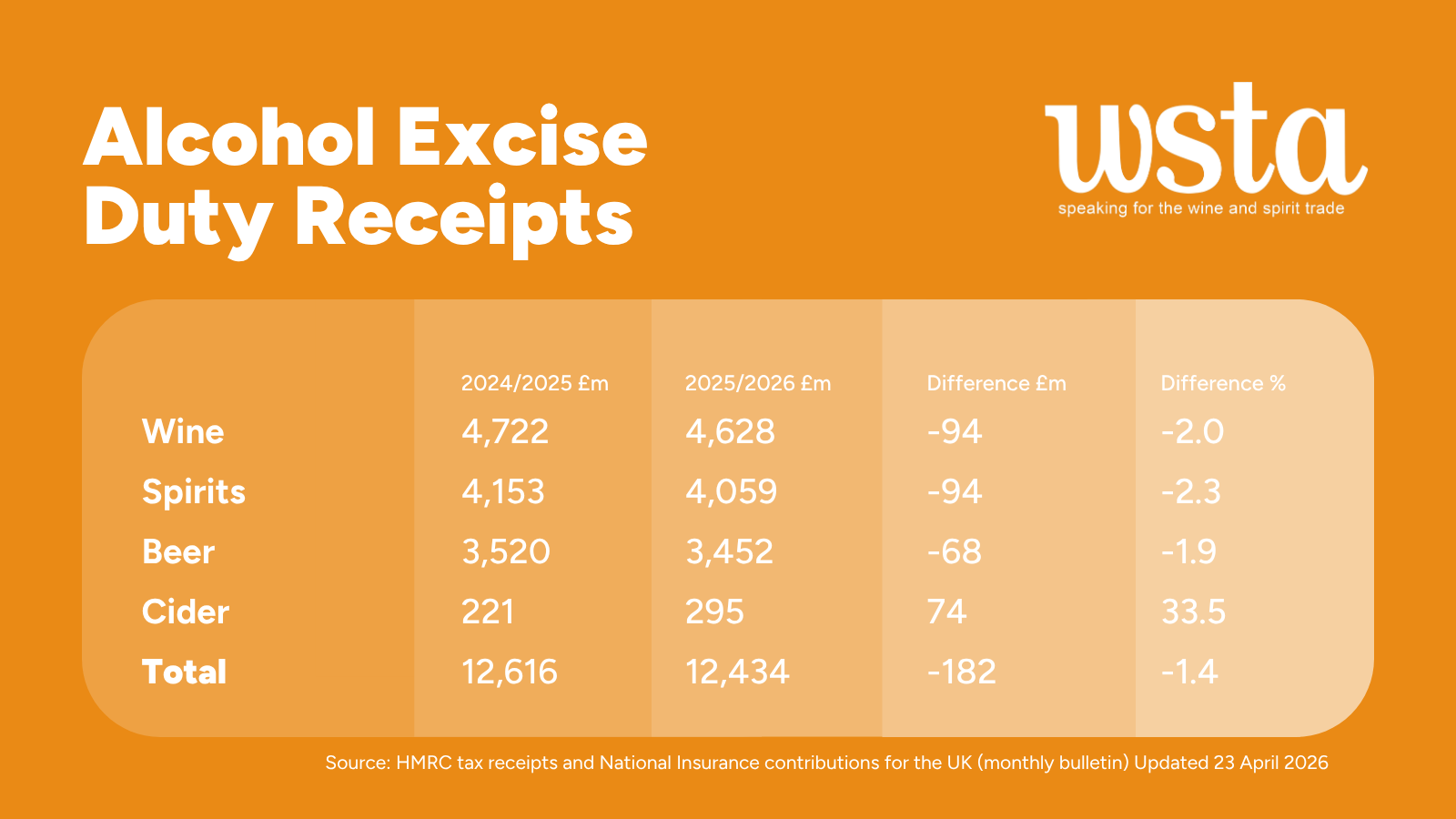
Image Credit: WSTA
In addition, the WSTA partnered with seven other organisations that represent the spirits trade across the UK and Ireland (including the English Whisky Guild, Drinks Ireland: Spirits, the Gin Guild, the Irish Whiskey Association, the Scotch Whisky Association, the UK Spirits Alliance and the Welsh Whisky Association) to release a joint statement on duty.
They said: "The Government’s own data shows that UK spirits producers, our supply chains and consumers across the country, can see the devastating impact of the 17% increase to spirits duty over the last three years.
“Spirits revenue is £1.1bn lower than was forecast when the new alcohol duty system was introduced in 2023.
“Spirits duty amounts to a super tax on the industry and must be urgently addressed.
“Pubs and the wider hospitality industry cannot survive on beer alone, yet hard pressed consumers are being forced to pay over the odds to responsibly enjoy premium spirits, which underpin the profitability of many bars, pubs and restaurants.”
It is worth noting that decreases to duty revenues can also be related to reduced alcohol consumption. However, this in itself is partially caused by the increased cost to consumers from higher duty.
As noted by Beale above, the government has announced that an evaluation of the current alcohol duty system has been launched, open for consultation responses until 1 June here.
The 2025/2026 alcohol duty revenue data can be found here.
Keywords:
Search
Digital Editions





56-58 Church Walk, Burgess Hill, West Sussex, RH15 9AN
Registered in England No. 6646125. VAT No. 938 4452 95
